what is farm to school?
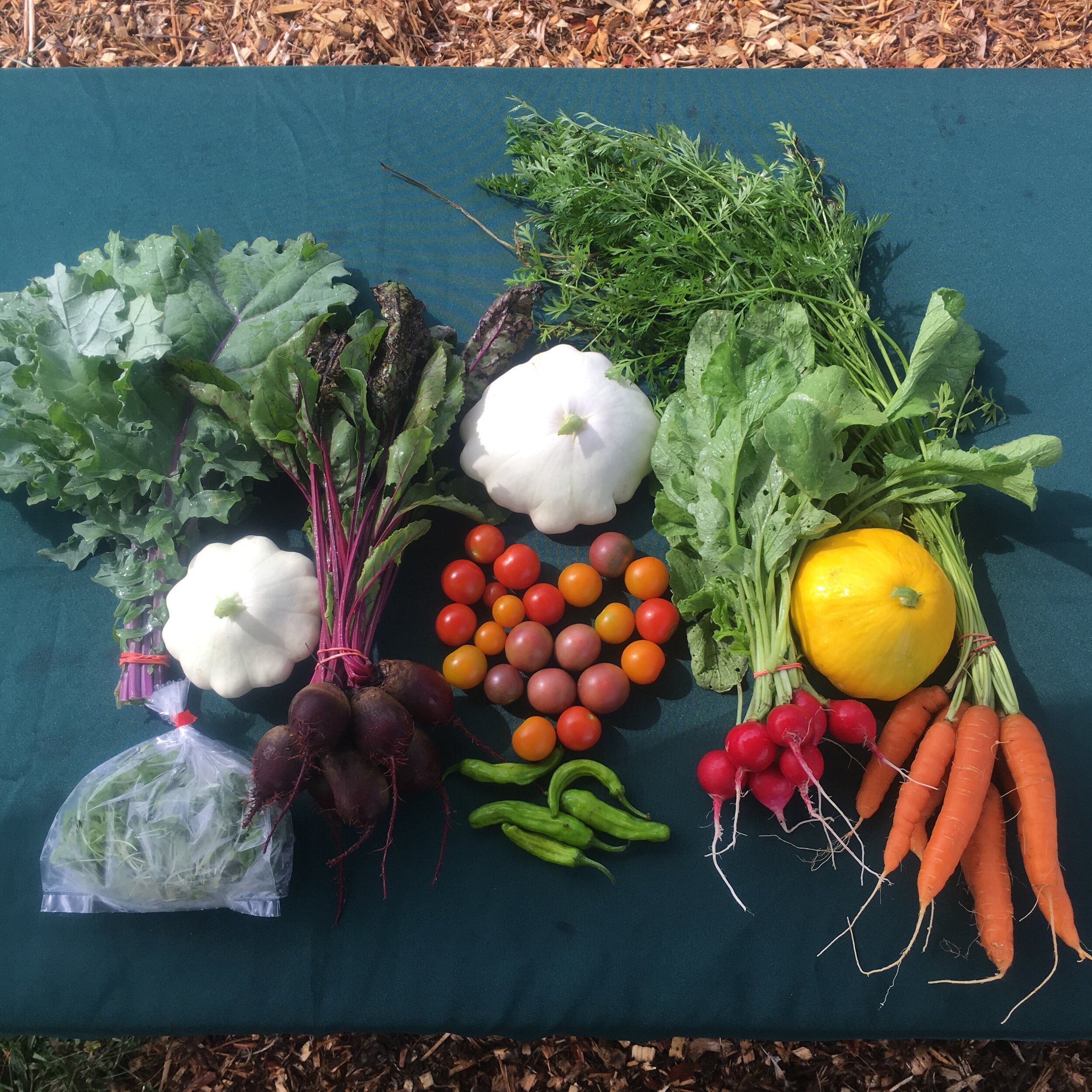
Farm to School programs aim to change the relationship children have with food by connecting schools with local farms and farm produce. These programs can serve as a meaningful food access intervention for low-income students who may have less exposure to fresh produce outside of school.
Why does CFS do this work?
- A recent study found that on average, ultra-processed foods supply about 60% of a child’s daily calories. Every additional 10% of calories from ultra-processed foods was associated with worse health measures, including higher blood pressure and cholesterol levels, as well as greater prevalence of diabetes and cancer.
- When children don’t consume nutrient-rich produce, they may experience forms of malnutrition – even when they consume enough calories. This can lead to weakened immune systems, lower energy levels, and impaired cognitive function.
- Getting sick more often and having difficulty concentrating in school can take a toll on student learning and academic performance: research consistently shows that food-insecure children have lower academic achievement, higher rates of absenteeism, and greater difficulty with concentration and behavioral regulation.
- Studies have found that children who are not exposed repeatedly to fruits and vegetables at a young age find it more difficult to form healthy eating habits later on in life – negatively impacting their health outcomes.
How CFS does this work:
Getting local produce into school cafeterias faces significant financial, logistical, and seasonal challenges. Our Farm to School program takes an alternative approach to bringing locally grown, fresh fruits and veggies to kids, with a process that is streamlined for our school partners. Our model below brings together 4 key elements for a holistic farm to school approach which we implement and measure impact through our programs and operations.
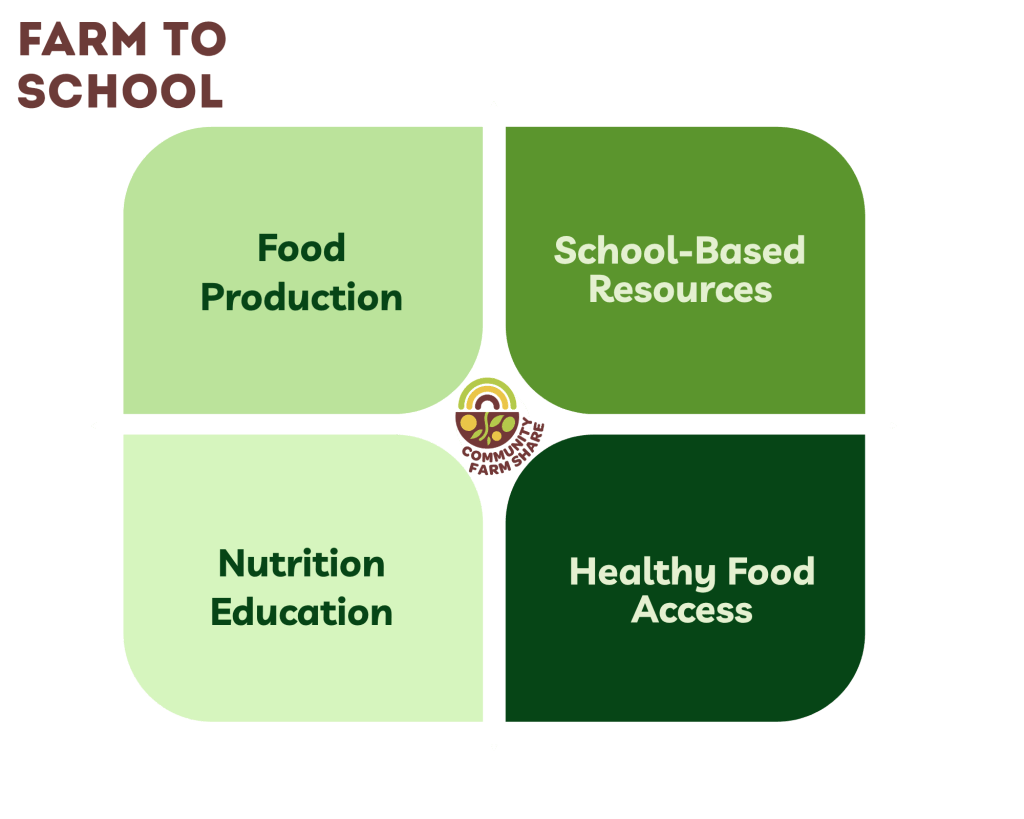
Food Production:
The foundation of Farm to School is bringing locally grown food into schools for children to eat. This food can come from local farms, or food can be grown directly on school sites.
Local farm production for Farm to School: the mismatch of the growing season (June-November) with the school calendar (September-June) actually provides an opportunity to get farm produce to students through non-traditional channels: schools can provide the space for our Mobile Farm Markets, when many children are not able to access free school meals. Bringing farm produce to markets located at schools helps connect families with real farm produce and the local farmers who grew the produce (read more about how we source produce from small farms here: Farm Support).
School farm production: In addition to offering local produce at our Mobile Farm Markets across the county, we partner with the Charles Koiner Conservancy for Urban Farming (CKC) at their Loiederman Middle School Farm Market, where CKC operates the REACH Hub and Farm. The REACH Hub and Farm at Loiederman is a school farm, growing produce for the community, designed to offer hands-on environmental education opportunities in an Equity Focus Area (EFA) of Montgomery County, MD.
School-Based Resources:
Montgomery County Public Schools (MCPS) are a trusted community partner where school support staff and case managers play key roles in linking families to a number of important social services. We believe integrating healthy food access services into a broader, holistic support network is the most effective approach to supporting families.
We bring our Farm to School program to MCPS schools with high Free and Reduced-price Meals (FARMS) rates and operate our program in close coordination with our MCPS school support staff partners, including Community Schools, Linkages to Learning, and Wellness Trainers with School-Based Health andWellness Centers (SBHWC). We recognize that our partners know their families best and support families across a wide variety of social services, including healthy food access. Our partners identify families at risk of food insecurity and refer them to enroll in our program.
Our work further supports our MCPS partners because our Mobile Farm Markets create another friendly community environment that helps us further understand community needs, which we share with our school partners. We also invite additional partners to share resources at our markets.
Healthy Food Access:
Healthy food access is most equitable and successful when provided in a physically and financially accessible manner, taking into consideration choice model, schedules, transportation access, and language preferences or barriers. This section describes our primary service delivery model:
- Our MCPS school support staff partners identify families at risk of food insecurity and refer them to enroll in our program. After our school support staff partners refer families to our program, we work with the families to enroll and onboard them.
- Enrolled families are able to either shop at our Mobile Farm Markets or to receive pre-packed bags, which can either be delivered to the school to go home with the child, or delivered to their home.
- If they opt to shop at our weekly free-choice Mobile Farm Markets, they receive an MC Market Card, which is preloaded with funds every month to shop at the markets.
- Our Mobile Farm Markets are open to the community beyond our families enrolled in Farm to School. We accept SNAP/EBT and SUN Bucks, both of which are matched by Maryland Market Money. We also accept cash and credit/debit cards.
- To learn more about our Mobile Farm Markets and Produce Bags, click here.
Nutrition Education:
Increased access to healthy food can change how kids eat, but it alone doesn’t necessarily change how they think about food! At our Mobile Farm Markets, our Nutrition Education Coordinator helps shoppers learn about the nutritional benefits of different produce and provides cooking and recipe ideas, including recipe cards with nutritional information.
We also partner with MCPS Community Schools to run SNAP-Ed during school hours, bringing locally grown fresh produce to K-2 classrooms across 14 schools. Wellness Trainers, trained by the SNAP-Ed curriculum, do a monthly tasting class with students who learn about nutrition and healthy living through yummy, nutritious, LOCAL food!

IMPACT: FARM TO SCHOOL
Farm to School creates a feedback loop between the school, its surrounding agricultural community, and families. It can honor regional food traditions, introduce kids to cultural crops, and give parents a shared point of pride and engagement with their school.
- Improved Health: Regular access to fruits and vegetables during children’s formative years supports physical and neurological health as their developing brains grow. Fresh, seasonal, local produce is particularly important for children, because fruits and vegetables eaten closer to harvest retain higher concentrations of vitamins and phytonutrients that degrade with time and processing.
- Academic and cognitive outcomes: Improved nutrition supports stronger immune systems, better concentration, attendance, and energy levels throughout the school day.
- Food literacy and lifelong habits: Introducing fruits and vegetables at a young age encourages children to form lifelong healthy eating habits! Research shows that children exposed repeatedly to a variety of vegetables, whole grains, legumes, and fruits during their early years are significantly more likely to accept and enjoy those foods throughout childhood and into adulthood – and that these children have stronger health outcomes later in life, including BMI, dental, brain, and gut health.
- Environmental impact: Shorter supply chains mean significantly lower transportation emissions than food shipped across the country.
- Local economy: Schools purchasing from local farms keeps dollars circulating within the local economy, helping farm businesses survive and grow.
CFS’s Impact:
- Each year, we serve about 560 families (~1,850 children) through our Farm to School program. In 2026, we are partnering with 19 MCPS schools: 15 elementary, 2 middle, and 2 high schools. We’ve distributed 96,000 lbs of produce through our Farm to School program.
- We fill an important gap in year-round, free, healthy food access (since it’s harder to get free school food during the summer).
- We’ve seen that many families shop at our Mobile Farm Markets with their kids, exposing their kids to where food comes from and making the connection between farms and real, whole food. We love seeing kids choosing the veggies for their family to bring home to eat!
- 844 classes across 14 schools participated in SNAP-Ed for SY25-26, with ~2,400 students each month trying delicious fresh local veggies!
“I appreciate that the vegetables and fruit are fresh – and you can taste it! And I had the opportunity to try new vegetables! Excellent service and everything was well organized. Thank you.”
-2025 program participant